
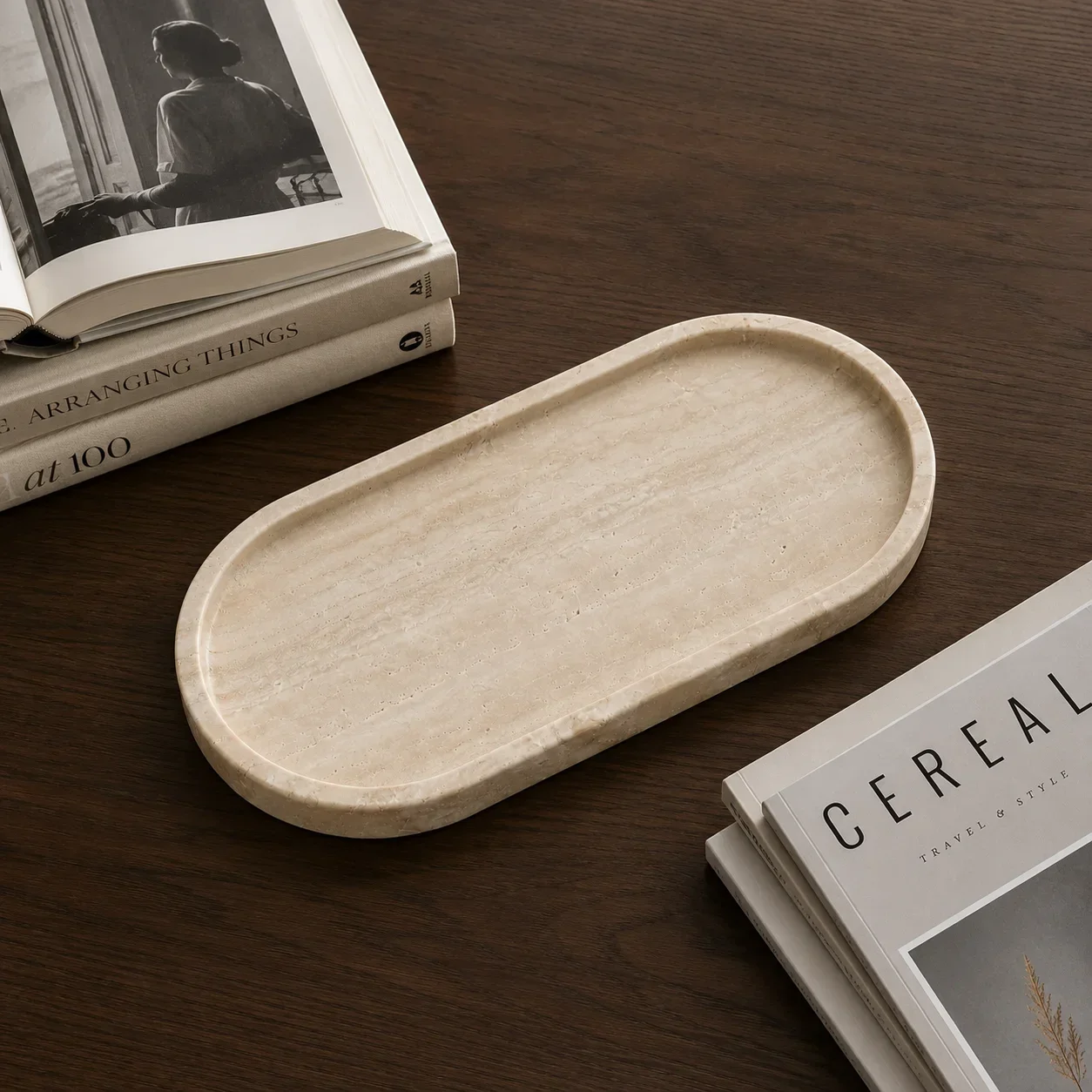
Vanity, candle, food-service and decorative trays may require different edges, sealers and tests.
Confirm dimensions, finish and acceptable natural variation rather than expecting identical veining.
Material, packing, labels, lead time and trade term must be visible before unit prices are compared.
Translate tray use into specifications
The same silhouette can carry very different performance requirements. Tell the factory where the tray will be used so material, finish and protection can be reviewed together.
| Program | Important decisions | Questions to confirm |
|---|---|---|
| Vanity and bath | Water exposure, sealer, edge comfort and bath-set coordination | Will water or soap remain on the surface? |
| Candle and decor | Heat exposure, wax contact, base stability and styling | Is the tray decorative or part of a tested candle system? |
| Jewelry and giftware | Fine surface finish, compact packaging and private-label presentation | Does the inner pack need to be retail-ready? |
| Food-service | Food-contact requirement, stain resistance and cleaning guidance | Which market and compliance standard applies? |
Product brief
Give the factory enough information to assess feasibility
Start with target length, width, height, usable area, edge profile, feet or handles, material preference and expected order quantity. A marked reference photo is useful, but a simple dimension sketch prevents assumptions about proportions.
Share the destination market and sales channel. A wholesale hospitality tray, a boxed gift item and a private-label bath accessory can follow different packing, testing and labeling paths even when the stone form looks similar.
Factory comparison
Look for control of natural variation, not impossible uniformity
Marble and travertine vary by block and cutting direction. Ask how the factory selects batches, grades color and veining, controls filled pores and separates pieces that fall outside the approved appearance range.
A suitable supplier should explain what can be repeated by machining and finishing, what remains naturally variable and which visual decisions require buyer approval before production.
- Request current material photos or a defined material range.
- Confirm thickness and dimensional tolerances at measurable points.
- Review edge comfort, underside finish and anti-scratch feet where applicable.
Sample approval
Create one approval record for form, finish and appearance
Approve the physical sample together with its written dimensions, weight, finish direction, sealer, logo position and packing construction. Photos alone are useful for progress review but can hide scale, surface feel and subtle color differences.
If a range includes several sizes or stones, identify which sample establishes the shared workmanship standard and which variants need separate confirmation.
Commercial comparison
Normalize quotations before comparing unit price
A comparable quotation states material, size, finish, quantity break, sample cost, lead time, unit packing, master carton, logo or label work and Incoterm. For CIF or DDP review, provide the destination port or complete delivery address.
Very low pricing may simply exclude retail packaging, export protection, inspection or a realistic material grade. Ask what is included before treating the difference as a production advantage.
Repeat production
Keep the approved standard usable after the first order
Record the stone direction, drawing revision, sample date, packing method and accepted variation range. Retained samples and measurement photos help both teams reproduce the program when the next order uses a different block.
For a collection, review related bowls, candle holders, soap dispensers or table lamps as a material and finish family rather than isolated SKUs. That creates a more coherent range and a more efficient sample plan.
RFQ checklist for marble trays
A first quotation becomes faster and more comparable when it includes:
- Reference image or drawing with target dimensions
- Intended use, destination market and expected annual quantity
- Preferred marble, travertine or alternative material direction
- Finish, edge, feet, logo and labeling requirements
- Individual packing and retail-box expectations
- Required trade term and destination port or address
Move from reference image to production brief
Send your tray reference, approximate dimensions, quantity and market. We can review material options, sample steps and export packing before a production quotation is confirmed.